Zinc–copper galvanic cell with a salt bridge

An example figure from the Electrochemical Cells generator.
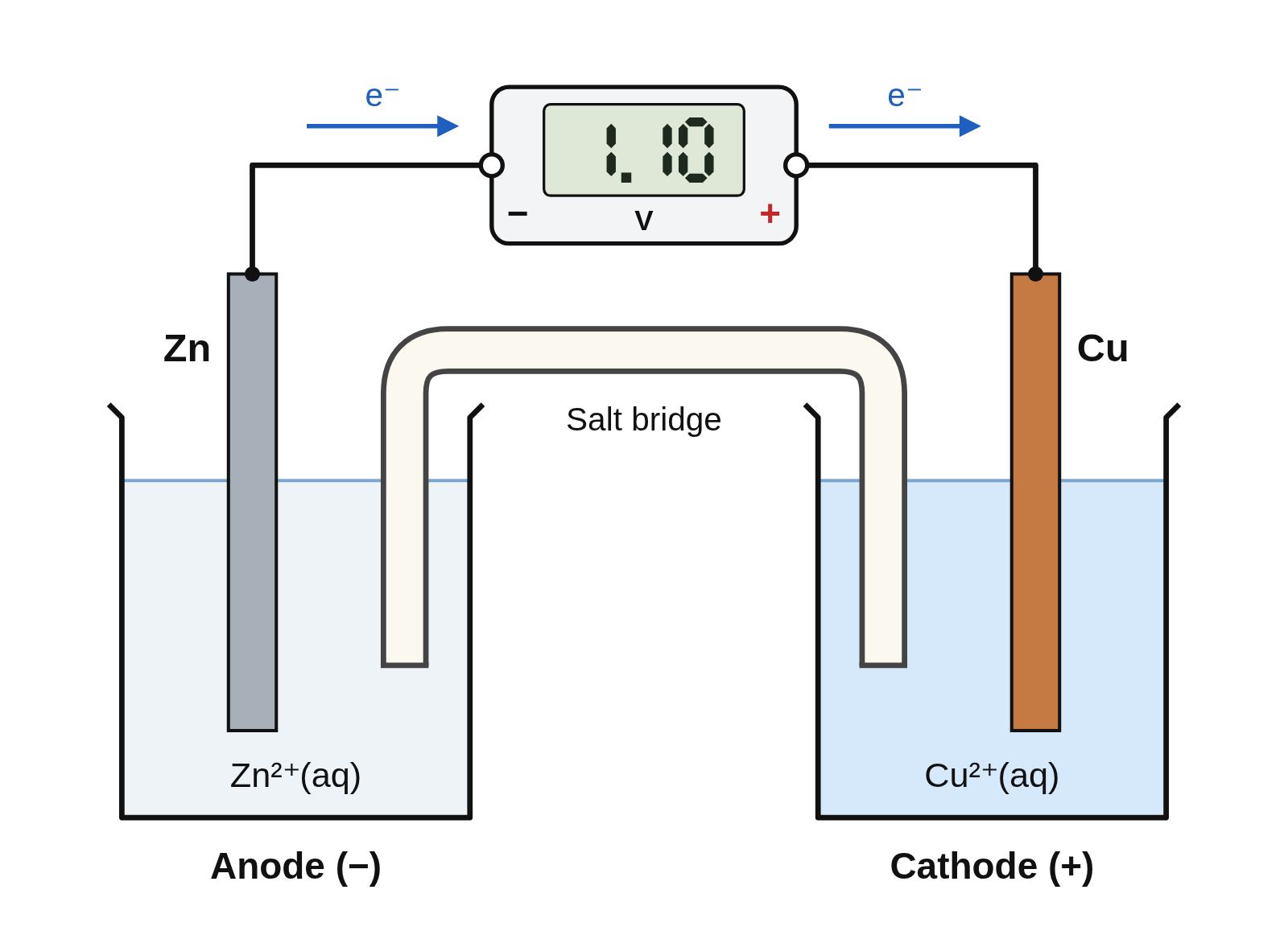
A zinc–copper galvanic cell: a zinc strip in Zn²⁺(aq) and a copper strip in Cu²⁺(aq), joined by a salt bridge and wired to a digital voltmeter reading 1.10 V, with zinc labeled Anode (−), copper Cathode (+) and arrows marked e⁻ along the wire from zinc to copper
A zinc–copper (Daniell) galvanic cell: a zinc electrode in a solution of zinc ions and a copper electrode in a solution of copper(II) ions, the two beakers joined by a salt bridge. A digital voltmeter wired between the electrodes reads 1.10 V. Zinc is labeled the anode (−) and copper the cathode (+), and arrows show electrons flowing through the wire from zinc to copper.

Editing opens it in Electrochemical Cells with these settings, to change anything and copy or download your own.

Answer key

  • Anode (−): Zn, oxidized: Zn(s) → Zn²⁺(aq) + 2e⁻
  • Cathode (+): Cu, reduced: Cu²⁺(aq) + 2e⁻ → Cu(s)
  • Overall: Zn(s) + Cu²⁺(aq) → Zn²⁺(aq) + Cu(s)
  • Electrons flow through the wire from Zn to Cu
  • E°cell = E°cathode − E°anode = 0.34 V − (−0.76 V) = 1.10 V

Free to use in your tests, worksheets, slides or anything else, no credit needed. Public domain under CC0 1.0. How to reuse our figures
More Electrochemical Cells examples