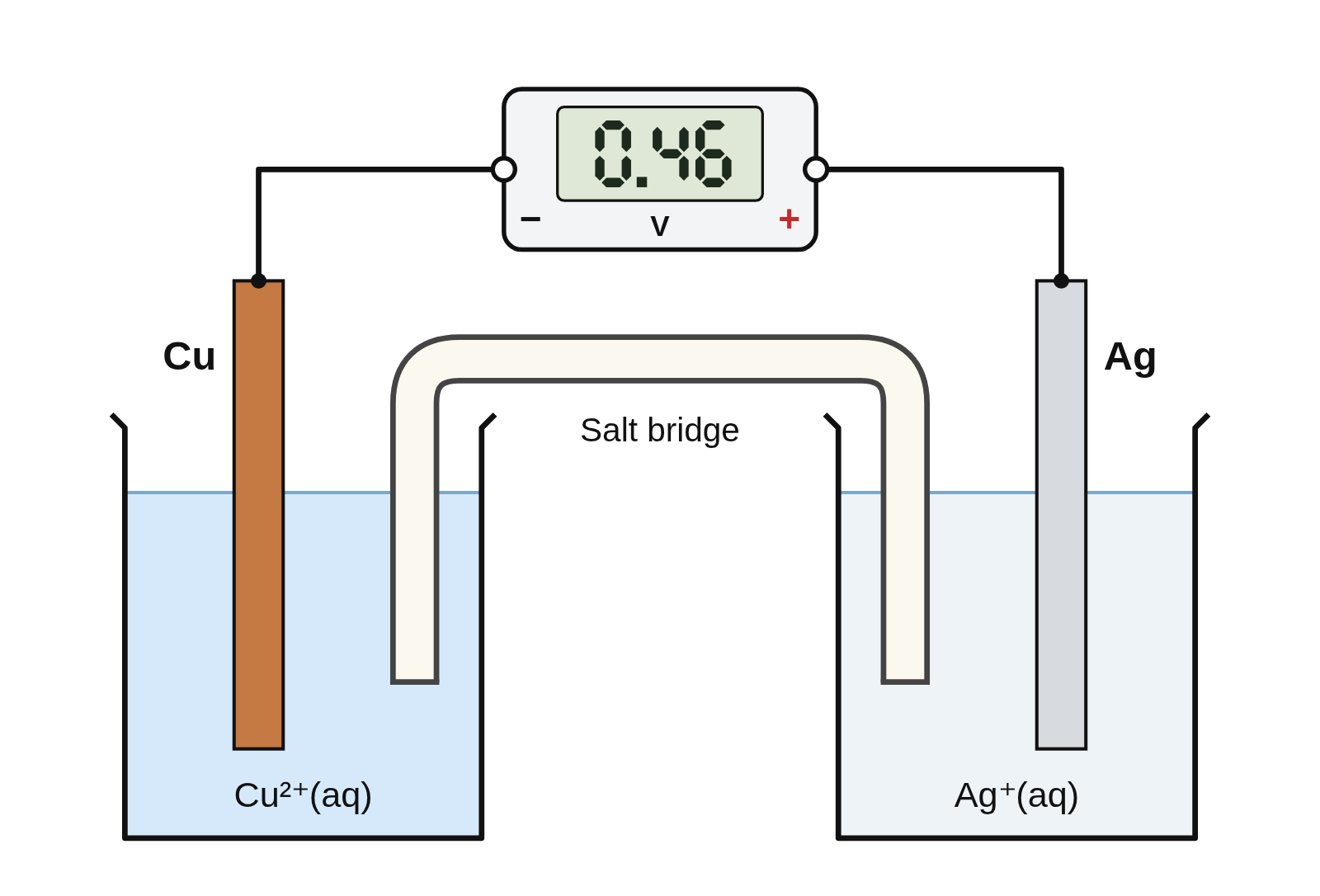
Copper–silver galvanic cell: label the anode and cathode
An example figure from the Electrochemical Cells generator.
Editing opens it in Electrochemical Cells with these settings, to change anything and copy or download your own.
Answer key
- Anode (−): Cu, oxidized: Cu(s) → Cu²⁺(aq) + 2e⁻
- Cathode (+): Ag, reduced: Ag⁺(aq) + e⁻ → Ag(s)
- Overall: Cu(s) + 2Ag⁺(aq) → Cu²⁺(aq) + 2Ag(s)
- Electrons flow through the wire from Cu to Ag
- E°cell = E°cathode − E°anode = 0.80 V − (0.34 V) = 0.46 V
Free to use in your tests, worksheets, slides or anything else, no credit needed. Public domain under CC0 1.0. How to reuse our figures